
Imagine you open a shop, but the door takes ten seconds to open. Would you wait? Most people won’t. Website speed works the same way. If your site is slow, people leave before they even see your content. And Google notices this too.
Website speed is not a hard, technical detail. It is a simple part of SEO that anyone can understand. In this post, we will look at how speed affects your rankings, your visitors, and your business. We will explain it in easy words, so even an average reader can follow along.
What Is Website Speed, Really?
Website speed means how fast your pages load. It sounds like a simple idea, but many things affect it. Images, code, hosting, and even your design can slow things down.
A fast site feels smooth and easy. Pages open quickly. Buttons respond fast. Visitors don’t wait around. This creates a simple, easy experience for everyone who visits.
A slow site feels the opposite. Pages take time to open. Images load late. People get frustrated and click away. This is bad news for your SEO, even if the fix is easy.
Why Does Google Care About Speed?
Google wants to give its users the best answer, fast. If your page takes too long to load, Google sees this as a poor experience. So it may rank your page lower.
Google made this official a few years back with an update called Page Experience. Speed became a direct, easy-to-measure ranking signal. Google also introduced something called Core Web Vitals, which measure real user experience, not just load time.
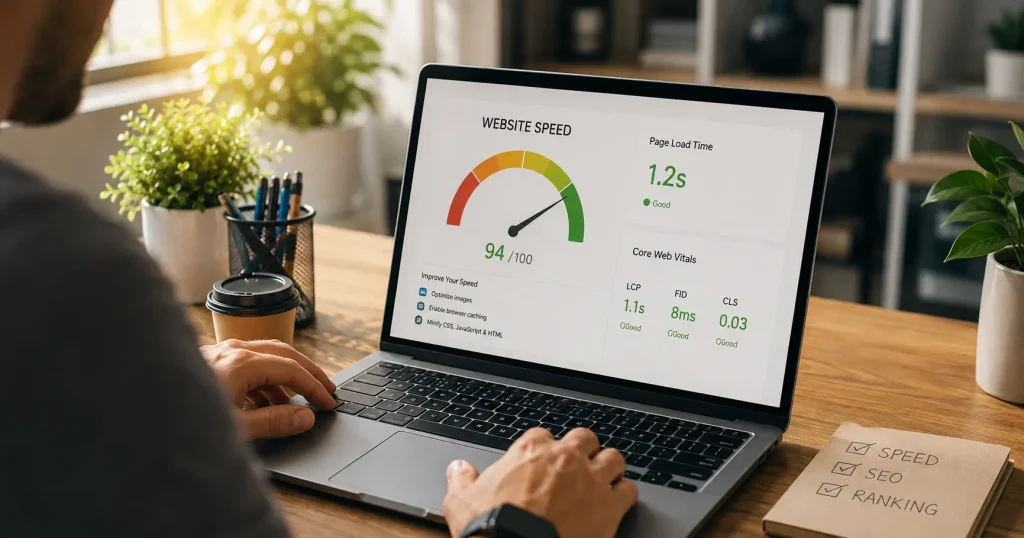
Here is a simple table to explain the main speed metrics Google looks at:
| Metric | What It Means | Good Score |
|---|---|---|
| LCP (Largest Contentful Paint) | Time for the main content to load | Under 2.5 seconds |
| INP (Interaction to Next Paint) | How fast the page responds to clicks | Under 200 milliseconds |
| CLS (Cumulative Layout Shift) | How much the page jumps around while loading | Under 0.1 |
These numbers may sound technical, but the idea behind them is simple. Google wants pages that load fast, react fast, and stay steady while loading. Checking your own score is easy too, using free online tools.
How Speed Affects Your Rankings
Speed is one of many ranking factors, but it plays an important role. A slow page can hurt you in a few simple ways.
First, people leave fast. This is called a high bounce rate. Google watches how visitors behave. If many people leave your page quickly, it may signal a poor experience.
Second, search bots crawl less. Google uses bots to scan your pages. A slow site means bots can check fewer pages in the same time. This can affect how well your content gets indexed.
Third, mobile matters even more. Most searches now happen on phones. Mobile networks can be slower than home Wi-Fi. So a heavy website becomes even harder to load on mobile. Google mainly uses the mobile version of your site to decide rankings. This makes mobile speed simple to ignore but costly if you do.
How Speed Affects Real Visitors
SEO is not only about search engines. It is about real people too.
A fast site keeps visitors happy. They can browse easy pages without waiting. This means they read more content, click more links, and maybe even buy something. A simple, fast layout keeps people on your page longer.
A slow site pushes visitors away. Studies have shown that even a one-second delay can lower conversions. People are busy. They don’t want to wait for a page to open.
Trust also plays a role. A fast site feels reliable and easy to use. A slow site can feel broken or old, even if the content is good.
Common Reasons Websites Load Slowly
Many small issues can add up and slow down your site. Some common ones are:
- Large, unoptimized images
- Too many plugins or scripts
- Poor hosting plans
- No caching system
- Heavy design elements like sliders and pop-ups
- Extra fonts or unused code
None of these problems are hard to fix. In fact, most of them have easy, simple solutions once you know where to look.
Simple Ways to Improve Website Speed
You don’t need to be a tech expert to make your site faster. Here are some simple, easy steps that help a lot:
- Compress your images. Large images are one of the biggest reasons for slow loading. Compressing them keeps quality but reduces size. This is an easy first step.
- Use good hosting. Cheap hosting often means slower servers. A better host makes a simple but big difference.
- Enable caching. Caching stores parts of your site so it loads faster the next time someone visits. This is a simple, one-time setup.
- Reduce plugins. Every plugin adds some load time. Keep only what you truly need.
- Use a Content Delivery Network (CDN). A CDN serves your site from servers closer to the visitor, making loading easy and fast.
- Minify code. This means cleaning up unused space in your website’s code. It is a small but simple fix with a real impact.
These steps are not hard to follow. Most website owners can apply them without deep, technical knowledge. Even one easy change can bring a simple, noticeable boost.
Speed and User Experience Go Together
Good SEO is not only about pleasing search engines. It is about giving people an easy, simple experience. When your site loads fast, everything else improves too. People stay longer. They trust your brand more. They are more likely to return.
Search engines simply reward what users already like. A fast site is easy and enjoyable to use. That is why speed and SEO are so closely linked, in a very simple way.
Why This Matters for Businesses Today
Online competition is high. If your website is slow, visitors will just go to a faster, easier site instead. This is true for shopping, news, blogs, and services.
Small businesses often assume speed only matters for big websites. That’s not true. Even a simple blog or a small shop website needs to load fast. Every second counts, no matter the size of your site.
Improving speed doesn’t need a big budget. Many small, simple changes can make a website noticeably faster. And these easy changes often bring long-term SEO benefits, not just a short boost.
Frequently Asked Questions
1. Does website speed really affect SEO rankings?
Yes, speed is a confirmed Google ranking factor, especially through Core Web Vitals.
2. How fast should my website load?
Ideally, your main content should load in under 2.5 seconds for a good, easy experience.
3. Does mobile speed matter more than desktop speed?
Yes, since Google mainly checks the mobile version of your site for rankings.
4. Can I improve my website speed without hiring an expert?
Yes, simple steps like compressing images and using caching can make an easy, noticeable difference.

One Response