
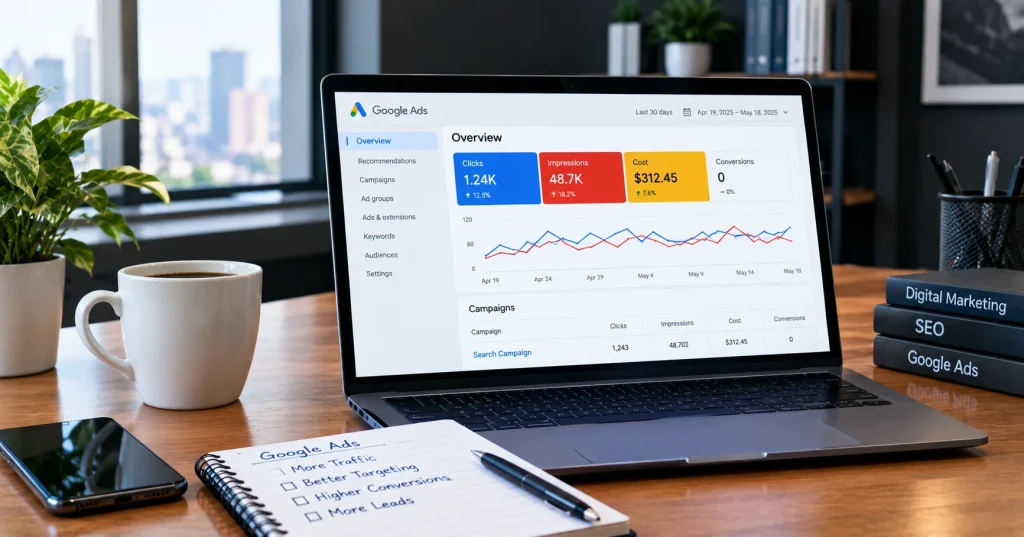
Running a Google Ads campaign and getting zero leads feels frustrating. You spend money every day, clicks come in, but the phone does not ring and the inbox stays empty. If this sounds like your story, you are not alone. Thousands of business owners face the same problem every month.
The good news is that most lead problems come from a small set of common mistakes. Once you find the real reason, fixing it becomes a lot easier. In this post, we will walk through the biggest reasons your Google Ads campaign may not be bringing in leads, using simple language and a few easy checks you can run today.
The Most Common Reasons Leads Are Missing
1. Your Landing Page Is Working Against You
Many advertisers spend weeks polishing their ads, then send traffic to a landing page that was never built for conversions. A slow page, a confusing layout, or a missing contact form can push visitors away in seconds.
Google itself tracks this closely through something called Landing Page Experience, which is part of your Quality Score. A page that loads fast, matches the ad’s promise, and guides the visitor clearly toward one action tends to perform far better than a generic homepage.
| Landing Page Problem | Why It Hurts Leads |
|---|---|
| Slow loading speed | Visitors leave before the page even opens |
| No clear call to action | People don’t know what to do next |
| Too many form fields | Long forms scare people away |
| Page doesn’t match the ad | Visitors feel misled and bounce |
| Not mobile friendly | Most clicks come from phones today |
A good landing page should feel easy to use. Visitors should understand what you offer within a few seconds, and filling out your form should feel like a simple task, not a chore.
2. You Are Targeting the Wrong Keywords
Keywords decide who sees your ad. If your keywords are too broad, your budget gets eaten up by people who were never going to buy from you. If they are too narrow, you may not get enough traffic at all.
For example, a broad keyword like “shoes” can bring in browsers, students, or people looking for a totally different product. A tighter keyword like “buy running shoes online” brings people who already know what they want. Choosing the right keyword is a simple idea once you separate browsers from real buyers.
Google explains how different keyword match types control this reach and relevance. Reviewing your search terms report every week is one of the most useful habits an advertiser can build.
3. Your Ad Copy Doesn’t Match Buyer Intent
An ad that talks about “quality service” or “best solutions” sounds nice, but it does not tell anyone why they should click or fill out a form. People respond to specific offers, clear numbers, and honest language.
A weak ad and a strong ad can target the exact same keyword, yet get totally different results. Small changes in wording are easy to test, and they often bring a big jump in leads.
| Weak Ad Line | Stronger Ad Line |
|---|---|
| “Best plumbing services” | “24 Hour Plumber. Fixed Price. No Call Out Fee” |
| “Quality dental care” | “Book a Dental Checkup Today. Same Day Slots” |
| “Affordable web design” | “Website Ready in 7 Days. Starting at $499” |
4. Your Budget and Bidding Strategy Don’t Match Your Goal
Some campaigns are set to “Maximize Clicks” when the real goal is leads, not traffic. This mismatch can quietly drain a budget without producing a single form fill. Switching to a goal like “Maximize Conversions” or setting a target cost per lead is a simple change that gives Google’s system a clearer job to do.
Budget size matters too. A daily budget that is too small may not let the algorithm gather enough data to find your best customers. Google Ads needs a fair amount of data before it learns who converts.
5. Conversion Tracking Is Broken or Missing
This is one of the most overlooked reasons for missing leads. If conversion tracking is not set up correctly, Google has no idea which clicks turned into a lead. Without that signal, the system cannot optimize your campaign toward the people most likely to convert.
This is an easy thing to check, and it should be done on a regular basis.
- Is the conversion tag firing correctly on the thank you page
- Are phone call conversions being tracked
- Are form submissions counted as a conversion
- Is there a mismatch between Google Analytics and Google Ads numbers
6. Your Ads Are Showing at the Wrong Time or Place
Location settings and ad scheduling are easy to overlook. A local business running ads nationwide wastes money on clicks that can never turn into local leads. Showing ads at 3 a.m. when your team is asleep also means missed calls and lost trust.
Reviewing your location targeting and ad schedule can quickly reveal wasted spend hiding in plain sight.
7. There Is Too Much Competition or Not Enough Differentiation
Sometimes the market itself is tough. If ten other businesses bid on the same keyword with a similar offer, your ad needs a real reason to stand out, such as a guarantee, a faster response time, or a limited time discount. Without a clear point of difference, even a well built campaign can struggle.
A Simple Checklist Before You Blame the Platform
Before assuming Google Ads itself is the problem, it helps to run through a short, simple checklist. This step alone often solves the mystery, because the fix is usually simple once you spot it.
- Open your landing page on your phone and time how long it takes to load
- Read your top three ads out loud and ask if they sound honest and specific
- Check your search terms report for the last 30 days
- Confirm conversion tracking numbers match your actual leads received
- Compare your bidding strategy with your real business goal
Final Thoughts
A Google Ads campaign that is not getting leads is rarely a lost cause. Most of the time, the cause is one or two fixable issues, not the platform itself. Landing pages, keyword choice, ad copy, tracking, and budget strategy are the usual suspects, and each one can be reviewed and improved step by step.
Take it slow, fix one thing at a time, and measure the change before moving to the next item. Small, steady improvements add up to a campaign that finally does what it was built to do, bring you real leads.
FAQs
1. Why am I getting clicks but no leads from Google Ads?
This usually means your landing page, offer, or tracking setup has a problem. The click is working, but something after the click is stopping people from converting.
2. How long should I wait before judging if my campaign is working?
Give a new campaign at least two to three weeks and enough clicks for the data to be meaningful. Judging too early often leads to wrong conclusions.
3. Does a higher budget always bring more leads?
Not always. A higher budget helps only if your landing page, keywords, and tracking are already set up correctly. Otherwise, it just increases wasted spend.
4. Is Google Ads still worth it for small businesses?
Yes, when it is set up with the right keywords, a fast landing page, and correct tracking, Google Ads remains one of the most reliable ways to bring in new leads for a small business.